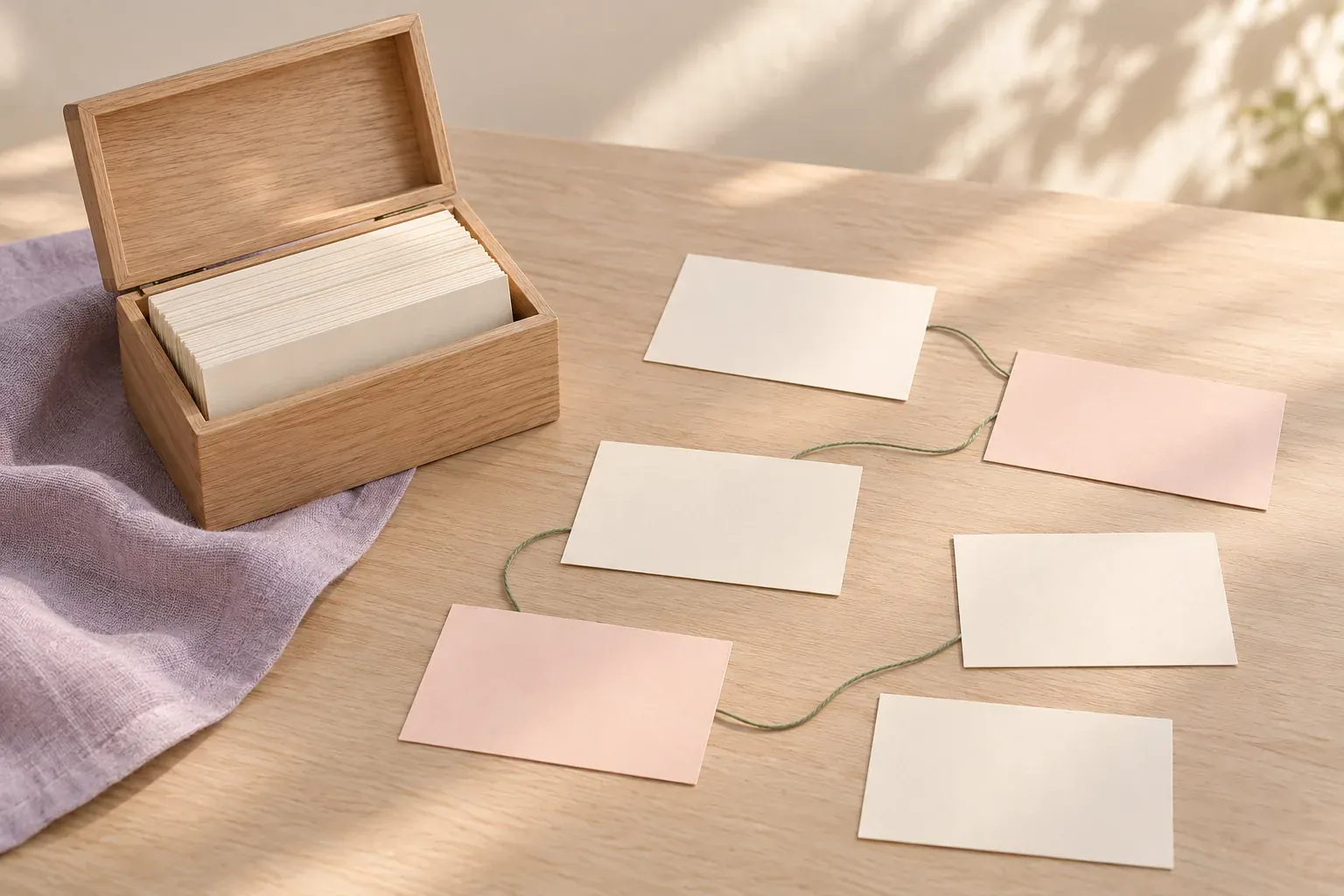
Short answer
A Zettelkasten is a “slip box”: a collection of small, individually addressable notes connected through meaningful references. The Zettelkasten method turns reading and observations into ideas written in your own words, then links those ideas so you can develop arguments over time. It can use paper or digital notes; the working relationships matter more than the tool.
What is a Zettelkasten, and what makes it different?
A folder tells you where something belongs. A Zettelkasten also asks what an idea contributes to other ideas. Instead of keeping an entire book summary under the book’s title, you can create several smaller notes: one explaining a claim, another questioning an assumption, and a third connecting the claim to something you already know. Each retains a path to the original source.
The German word refers to a box of slips or notes. In contemporary use, the important distinction is not the box but the network: notes have stable addresses, enough context to make sense later, and explicit relationships. A directory filled with copied highlights is not yet doing this work. Neither is a graph with many lines whose meanings you cannot explain.
You can combine this approach with other note-taking methods. A lecture outline records an event; a slip-box note develops an idea from it. A commonplace book may preserve passages worth returning to, while a Zettelkasten emphasizes your response and the connections between notes. These are complementary practices, not competing identities.
Niklas Luhmann’s slip box: what the archive actually says
The sociologist Niklas Luhmann is closely associated with this approach. The Niklas Luhmann-Archiv describes a collection of approximately 90,000 slips, organized into two collections. That is an approximate archival total, not a target for beginners, and not 90,000 polished essays. The archive distinguishes content notes, bibliographic material, keyword-register slips and other kinds of records.
In Johannes F. K. Schmidt’s scholarly account, Luhmann’s system combines an address for each card, branching sequences, cross-references and a keyword index. He developed reading notes into cards rather than simply depositing all his initial excerpts. The index offered entry points into a web of references rather than an exhaustive list of every relevant card.
Borrow the useful mechanics without treating one scholar’s lifetime practice as a universal recipe. You do not have to imitate his handwriting, buy the same card size or reproduce a complex branching number on every note. Nor does the size of his archive establish that the method alone caused his publication output. The practical question is whether your own notes support the thinking and writing you need to do.
Fleeting, literature and permanent notes
Sönke Ahrens popularized a modern workflow in How to Take Smart Notes, first published in 2017 and revised and expanded in a second edition in 2022. His author-provided preview verifies those edition dates. A familiar beginner shorthand distinguishes fleeting, literature and permanent notes, but these are not three completely separate bins in Ahrens’ terminology: literature notes can themselves be permanent records.
- Fleeting note
- A temporary capture: a question, a rough thought or a reminder of something to examine. Include enough context to process it later; do not expect a cryptic phrase to remain intelligible for months.
- Literature note
- A concise record tied to a source. Identify the work and relevant page or section, summarize the useful point in your own words, and keep any exact quotation visibly distinct from your paraphrase.
- Permanent idea note
- A self-contained contribution to your working collection: an explanation, argument, distinction or question that you can connect to other notes. Here “permanent” means intended for continued use, not forbidden to revise.
The specialist explanation of Ahrens’ note categories makes this terminology explicit. For everyday use, label the job a note is doing rather than worrying about perfect names. A source summary and your own claim can sit near each other, but readers—including your future self—should know which is which.
The Zettelkasten method in five practical rules
- Give each note one main idea. Keep the context needed to understand it, but split a note when it makes two independently useful arguments.
- Write in your own words. Explain the idea as though a reader has not just finished the same source. Preserve technical terms and qualifications rather than paraphrasing them into a different claim.
- Add meaningful links. Say whether another note supplies an example, challenges a premise, extends an argument or uses the same distinction elsewhere.
- Use stable IDs. A simple address such as N001 works on paper; a durable filename or note identifier can work digitally. Changing a title should not make the note impossible to find.
- Maintain an entry index. Start with a short list of questions or topics and a few useful note addresses under each. Treat it as a doorway, not a second copy of the whole collection.
These are practical adaptations of the linked, addressable system, not a claim that every historical card obeyed a modern “one idea” rule. The unit should be small enough to reuse and large enough to say something. A two-word fragment is not automatically better than a careful paragraph.
Before filing a new note, ask where it enters an existing conversation. If there is no connection yet, keep it with a clear question or index entry rather than inventing a weak link. After adding a useful connection, revisit the older note: its explanation may need a pointer back or a qualification. Linking is editorial work, not a quota.
A fictional example: from reading to connected ideas
Imagine you are planning an essay about a fictional community workshop. All the following material is invented for illustration, not participant research. Your rough capture says: “People don’t know whether they need to bring tools.” That is a fleeting note until you identify what prompted it and decide what it means.
- Source note S01: an invented workshop announcement lists activities but does not specify supplied materials. Record its fictional status and the relevant part of the announcement.
- Idea note N001, “Preparation instructions set expectations”: explain that an announcement should distinguish what is supplied from what visitors bring. Cite S01 as the example, not as evidence about all workshops.
- Idea note N002, “A useful invitation answers the next practical question”: compare preparation instructions with directions and arrival information. Link to N001 as one case of that broader distinction.
- Question note N003: ask whether an illustrated materials checklist would be clearer than prose in this fictional situation. Link it to N001 as a possible approach to examine, not a proven solution.
The sequence creates something you can write with: an observation, a limited interpretation, a broader idea and an open question. If later reading contradicts your interpretation, add the conflicting source and revise the claim. Do not quietly transform a fictional example into evidence merely because it now has a neat ID.
Analog vs digital: choose the friction you can maintain
Paper suits a small collection you want to handle at a desk. Write the ID on each card, put related addresses in the text or margin, and keep an index card near the front. Leave room to add references. A card can live in one physical position while references bring it into several conversations; you do not need a duplicate for every subject.
Digital notes suit a collection you need to search, revise or work with across locations. Before committing to a tool, try the ordinary jobs: create a note, link to it, rename it without breaking the reference, find a source and preserve your work outside the tool. A visually impressive graph is secondary to readable notes and recoverable records.
A broader second brain can also hold tasks, reference files and project material. Your Zettelkasten can be one part of that arrangement rather than a container for everything. Keep logistics such as appointments separate from developing ideas unless there is a real reason to connect them.
A spatial variant with clusters and connections
A visual adaptation lays out a small selection of notes around a current question. Put an argument in one cluster, its supporting examples nearby and its strongest objections in a separate area. Keep IDs and source references on the notes: position alone is not a stable address. This uses visual thinking to inspect the collection rather than replacing written relationships with decoration.
Make a note beside each important connection explaining what it means. “N004 qualifies N001 when the event has several arrival times” tells you more than an unlabeled line. Preserve a small index of useful starting notes so you can return even after the layout changes. The canvas is a working view of a conversation, not necessarily a map of every note you own.
Canvas Perch can keep notes, images, links and files side by side on an infinite canvas, with connections between cards and selected cards grouped inside a frame. For a personal knowledge practice, you can use that space to compare a few connected ideas while keeping sources nearby. This spatial workflow is an adaptation, not a claim of a dedicated Zettelkasten system.
For notes made primarily through diagrams or sketches, visual note-taking offers a related approach. A sketch can become a source for an idea note, provided the written explanation survives outside the original page.
Common mistakes that turn a slip box into a storage pile
- Copying without responding
- Keep the excerpt if you need it, but add what you understand, question or want to use. Otherwise you are maintaining a quotation archive, not developing a line of thought.
- Splitting until context disappears
- One idea per note is not one sentence at any cost. Explain the conditions, example or definition that makes the point interpretable.
- Linking because words match
- Two notes mentioning “community” need not support the same argument. Write the relationship before adding a connection.
- Designing the whole taxonomy first
- Start with a few entry points and let useful distinctions emerge. Do not postpone reading and writing to name every possible folder.
- Measuring only note count
- Look for an output: a clearer paragraph, a better question or a comparison you can explain. Ten connected notes can be more useful to a task than a large unprocessed backlog.
A one-week Zettelkasten starter workflow
Use this as a suggested practice schedule, not a required certification. Choose one question you actually want to explore and one manageable source. Begin with new material instead of importing years of old highlights. Keep the daily work small enough to repeat.
- Day 1: choose paper or a digital tool, create an index and decide on a simple stable ID format.
- Day 2: read a short source. Capture a few fleeting notes with enough information to locate the passages again.
- Day 3: write a concise literature note. Record the title, creator, link or file, and relevant pages or sections.
- Day 4: develop two idea notes in your own words. Give each a descriptive title and a source reference.
- Day 5: compare the notes. Add a meaningful connection or explain why they should remain separate; create a useful index entry.
- Day 6: add another source or an objection. Keep any disagreement visible rather than folding it into a falsely tidy summary.
- Day 7: write a short paragraph from the connected notes. Notice what is missing, adjust the notes and choose the next question.
At the end, judge the workflow by what you can do with the notes. Can you find the source, explain the link and turn the collection into a small piece of work? If not, repair that step before adding more volume. A maintainable slip box grows through use, not through the pressure to capture everything.
Questions and answers
What is a Zettelkasten?
A Zettelkasten is a slip-box collection of small notes with stable addresses and meaningful references between them. Its purpose is to develop and reuse ideas, not merely store excerpts.
What are the three types of Zettelkasten notes?
A common beginner shorthand is fleeting notes for temporary capture, literature notes for source-based records, and permanent idea notes for your connected explanations. In Ahrens’ terminology, literature notes can also be permanent; the three labels are not mutually exclusive categories.
How many notes were in Niklas Luhmann’s Zettelkasten?
The Niklas Luhmann-Archiv describes approximately 90,000 slips across two collections. That total includes different kinds of records, including bibliographic and index material, and is not a recommended goal for beginners.
Do I need special software for the Zettelkasten method?
No. Paper cards with IDs, cross-references and an entry index can work. Digitally, choose a tool that lets you maintain readable notes, reliable references and a path back to your sources.
How long should a permanent note be?
Long enough to explain one main idea without relying on the source being open beside it. A clear paragraph can work; add context when necessary and split the note only when separate ideas would be independently useful.