Short answer
Worldbuilding is the work of designing a story’s setting and the rules that shape life within it. It includes places, history, cultures, institutions and any invented technology or magic. Start with the details that affect your characters’ choices, then record their consequences in a world bible. A useful worldbuilding template gives you questions, not a requirement to invent everything before writing.
What is worldbuilding, and how much do you need?
A setting becomes a world when its details have relationships. A harbor is not only a view: someone maintains its boats, decides who can enter and pays when a crossing fails. You can build a whole invented planet or the few streets around a realistic novel. The useful question is not how large your world is, but what a reader needs to understand the events that happen there.
Begin with the story’s pressure point. If a courier must reach an island before a gate closes, you need travel conditions, the gate’s purpose and the consequences of missing it. You probably do not yet need the island’s complete royal genealogy. A detail earns its place when it changes an action, explains a constraint or gives a scene a specific texture.
Patricia C. Wrede’s worldbuilding questions published by SFWA explicitly present questions as optional prompts rather than prerequisites for writing. The original question lists below follow that practical principle: choose what your story needs, leave other fields open and return when a scene raises a better question.
Choose top-down or bottom-up worldbuilding
- Top-down
- Start with broad rules, such as the geography, political arrangement or source of magic, then work toward towns, households and scenes. This is useful when a large system drives the central problem.
- Bottom-up
- Start with one character, place or immediate situation, then expand outward as questions arise. This is useful when a vivid local experience is your entry point.
These are working directions, not competing schools you must join. Try both on the same premise. From above, an archipelago whose bridges open only at low tide suggests questions about schedules, trade and authority. From below, a courier arriving at a closed bridge suggests questions about who controls the latch and why the courier cannot wait.
Meet in the middle. Write one broad rule, one ordinary consequence and one scene-level difficulty. In our clearly fictional example, the town of Bellwater uses tide gates to protect its inner harbor. Every crossing requires an authorized keeper. A courier named Mara discovers that the keeper has refused her permit. That small chain is enough to start drafting while the rest of the map remains unfinished.
A worldbuilding template for geography, history and daily life
Copy these question groups into your notebook. For each group, write a current answer, an open question and a scene where the answer matters. Mark invented rules separately from real-world research. If you use a real place or historical practice, keep its source beside the note rather than trusting a reference image to explain it.
- Geography and climate: Where does the story happen? What lies between important locations? What seasonal conditions matter to this journey? Which routes are available, dangerous or restricted?
- History: What earlier event still affects the present? Who remembers it differently? Which building, law, family obligation or damaged object makes that history visible now?
- Cultures and daily life: How do people get food, find shelter, work, rest and care for one another? What differs between households, regions and generations? What does a visitor misunderstand?
- Language and naming: How are people and places named? Which names have formal, intimate or disputed versions? What vocabulary does a character use because of their work or background?
- Religion and belief: What do people practice, question or reject? Which observances shape ordinary schedules? How do individual believers differ? What sources or perspectives do you need before drawing on a living tradition?
For Bellwater, an initial answer might be: homes face the sheltered harbor; a former flood is remembered through an annual repair day; quay workers use practical names for crossings while officials use registered names. These are invented choices, not claims about a real coastal culture. Each can enter a scene through work, dialogue or a missed appointment.
Handle belief and culture as lived experience, not decorative shorthand. Avoid giving every member of a group identical opinions or assigning real sacred practices to a fictional villain simply because they look unfamiliar. When real traditions inform your work, research context and contemporary perspectives, identify what you changed and seek informed feedback where appropriate. You can leave a detail out if you cannot treat it carefully.
Questions for power, economy, technology and magic
The second half of the template asks who can do what, and at whose expense. Do not keep these systems in isolated folders: a machine’s fuel supply can affect the economy, and an official permit can turn an ordinary trip into a political choice. Write consequences across categories.
- Power and politics: Who makes decisions? Who enforces them? Who can appeal? What informal influence matters alongside the official rules? What happens when authorities disagree?
- Economy: What do people exchange? Who produces necessities? What does your protagonist earn, owe or lack? Which interruption would make daily life harder?
- Technology: What tools are available to this character? Who builds and repairs them? What resources, knowledge or infrastructure do they require? What can they not do?
- Magic: What can a practitioner attempt? What does it cost? What limits access, range, duration or reliability? What happens when it fails? How do other people respond to its use?
- Unequal access: Who benefits from each system, who is excluded and who works around it? What does the protagonist know about these differences at the beginning?
Suppose Bellwater’s tide gates use enchanted hinges. The invented rule is that each opening consumes a prepared salt crystal; the hinges cannot move when the crystal is exhausted. Keepers control the supply. This creates a material cost, a limit and a possible abuse of power. If the climax needs an extra opening, establish a believable source of another crystal earlier rather than suddenly removing the rule.
You do not need to explain every mechanism. Decide what readers can rely on and what characters remain uncertain about. A mysterious system can stay mysterious while still having consistent observed consequences. Record an exception as an exception, with its conditions, instead of quietly treating it as the new normal.
Build a world bible you can actually maintain
A world bible is your working reference for established setting details. It is not necessarily an encyclopedia or a document readers will see. Keep it small enough to consult during a draft: a location list, a timeline, a naming list, system rules and the decisions already used in scenes.
- Record: a short identifier and the current fact or rule.
- Status: established in the draft, proposed, disputed in-world or still undecided.
- Scope: where and when the rule applies, including known exceptions.
- Appearance: the scene or chapter where the reader encounters it.
- Dependencies: other details that must change if this one changes.
- Research: a source link for borrowed real-world information, or a clear fictional label.
A Bellwater entry might read: GATE-01; one salt crystal per opening; established in chapter two; applies to the inner harbor gate; depends on the keeper’s supply inventory. Another entry might say that Mara believes the last crossing is at dusk, while the actual schedule remains undecided. That separation keeps a character’s assumption from accidentally becoming the author’s rule.
When you revise, update the current entry and briefly record what changed. If you move a flood from ten years ago to five years ago, check ages, repairs and memories that depended on the older date. A useful bible points you toward affected scenes instead of merely accumulating lore.
Make a visual worldbuilding board with maps and timelines
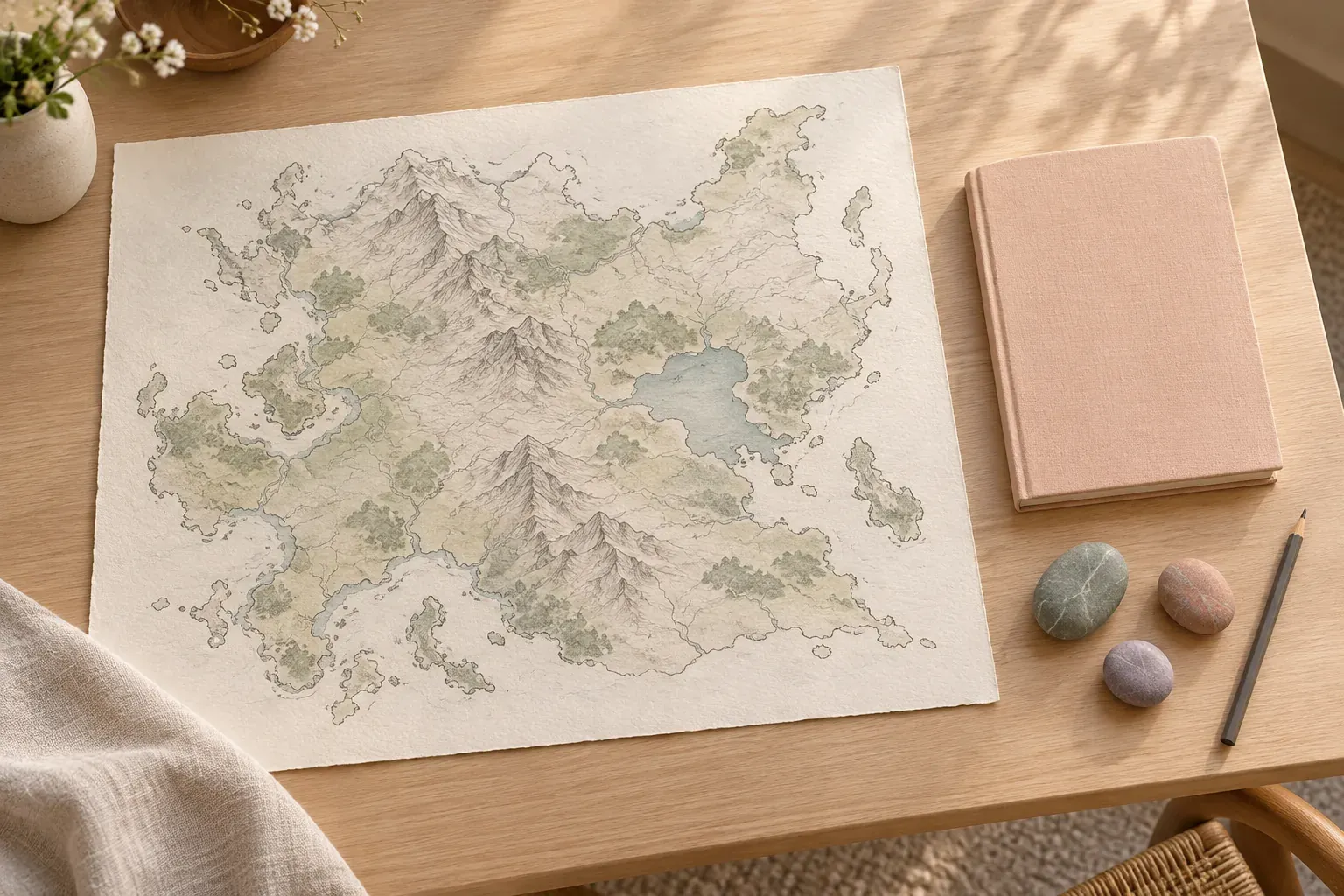
Use a map for spatial relationships, a timeline for sequence and a mood board for atmosphere. These answer different questions. A misty coastline photograph might suggest a scene’s feeling, but it cannot establish your invented harbor’s dimensions or a real place’s history. Label references by what you are borrowing: texture, light, construction or a researched fact.
Make separate areas for locations, systems and unresolved questions. Put a location sketch near the scenes that use it, then attach notes explaining the relationship. Keep distances and routes in words as well as on the map. A beautiful coastline is not helpful if you cannot tell whether the courier has enough time to cross it.
Canvas Perch’s creative-writing use case describes keeping characters, settings, motifs and scenes visible together. Its infinite canvas can hold images, notes, links and files side by side, with connections and frames for related material. The board is a place to explore your relationships, not a tool that decides your story.
For a fictional mystery inside the world, borrow the source-versus-interpretation distinction from an evidence board. Keep the author’s actual event sequence separate from rumors and from the protagonist’s knowledge. Otherwise, a clue may accidentally refer to something the character has not learned yet.
Turn worldbuilding into scenes instead of info dumps
Reveal a detail when it affects an immediate choice. Mara does not need to explain the whole gate system at breakfast. She can arrive with her permit, hear that the crystal supply is exhausted and decide whether to wait, bargain or risk another route. Readers learn the rule while watching the character respond to it.
A short explanation can still be useful. Give readers enough context to understand the stakes before asking them to follow a difficult decision. The goal is not to ban exposition; it is to avoid a block of information that interrupts the action without helping the current scene. If a paragraph answers a question the reader has no reason to ask yet, consider moving it.
- Need now: the gate closes soon, and the official route is unavailable.
- Useful texture: repaired flood marks on the quay steps.
- Possible later reveal: why one family controls the crystal store.
- Private author knowledge: the complete succession of former keepers.
Use your story arc to place revelations where they change the reader’s understanding. Use a character profile template to decide what this particular narrator notices. A keeper and a visiting courier should not automatically describe the harbor with the same priorities.
Run a consistency check before expanding the world
Read the draft with a few practical questions rather than adding another hundred background facts. Check the rules at their most demanding moments: journeys, shortages, confrontations and solutions. A contradiction matters most when it removes a cost the story previously asked readers to take seriously.
- Travel: Do distances, available routes and elapsed time agree?
- Knowledge: Who knows each fact, and when did they learn it?
- Resources: Can a character obtain, carry or afford what the scene requires?
- Authority: Does this person have the permission or influence they use?
- Systems: Does the solution obey established costs and limits?
- Variation: Are people within a culture allowed distinct motives and beliefs?
- Revision: Which earlier scenes now need updating after a changed rule?
When a check fails, choose deliberately: revise the scene, revise the rule everywhere it applies or establish a meaningful exception. Then draft the next scene. Worldbuilding has done its job when the setting gives your characters specific possibilities and constraints, not when every open question has disappeared.
Questions and answers
What should a worldbuilding template include?
Include questions about geography, climate, history, daily life, culture, power, economy, technology or magic, naming and belief. Add a place to record established answers, uncertainties and the scenes they affect. You do not need to fill every field before drafting.
Should I start with the world or the characters?
Start with whichever gives you a concrete story problem. A large system can lead to a character affected by it; a character’s immediate difficulty can lead outward to the world. Connect one broad rule to one personal consequence before expanding either approach.
How do I avoid too much worldbuilding?
For each detail, name the choice, scene or continuity question it supports. Leave unrelated background undecided and write a scene using the rules you already have. Return to research or invention when the draft exposes a specific missing detail.
What is the difference between a world bible and a worldbuilding board?
A world bible records current facts, rules and continuity decisions. A worldbuilding board makes spatial relationships, visual references and open questions visible. Use the bible as the current record and the board as a working arrangement, with clear labels for proposed ideas.
Does worldbuilding only apply to fantasy?
No. Realistic fiction also needs coherent places, institutions, routines and social relationships. The difference is that claims about the real world require research rather than invention. Mark invented people and situations clearly when they sit beside factual references.