Short answer
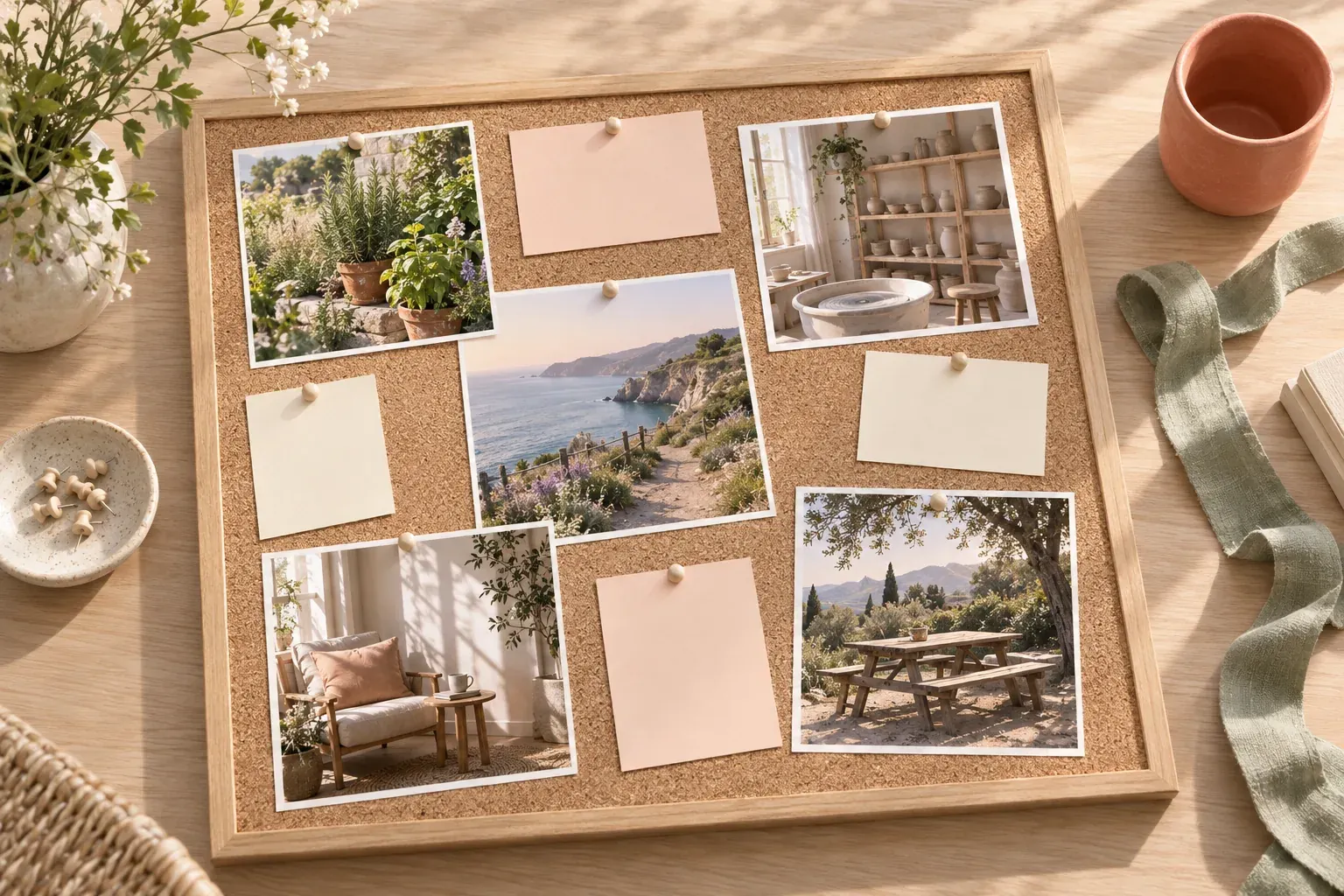
Useful vision board ideas include a skill you want to practice, a place you want to explore, a more comfortable home and time with people you care about. Choose images that mean something specific to you, then connect each to an action you can influence. A vision board supports reflection and planning; displaying a picture does not cause the pictured outcome.
Which vision board ideas belong on your board?
Start with the part of your life you want to pay attention to, not with a finished collage you want to copy. A board can be about an ordinary week: making room to read, setting up a worktable or visiting a nearby park. It does not need luxury purchases, dramatic transformations or a complete set of life goals. Dream board ideas can be modest without being less meaningful.
If you are still choosing the tool rather than its contents, read what a vision board is. This page is an idea bank, not another assembly tutorial. The digital vision board guide covers the full layout and editing process once you have chosen your references.
- Specific: can you explain what this image represents without saying only “success” or “happiness”?
- Personal: would you still want this experience if nobody else saw it?
- Actionable: is there a small decision or experiment you can make, even when the larger result is uncertain?
- Compatible: does it leave room for your actual time, access, responsibilities and resources?
A useful test is to finish the sentence “This belongs because I want to make room for…” If the answer is simply that the photograph is beautiful, save it as visual inspiration instead. You can admire a mountain cabin without wanting to live in one.
Vision board categories for work, learning and creative practice
Categories are optional shelves for ideas, not boxes you must fill. Work and learning can share a space when the same reference serves both; creative practice may deserve its own area if you want it protected from career expectations. Use your own photographs of tools, places and unfinished work where possible. The process can be more revealing than an image of a finished award.
- Work you want to do more of
- Choose an image of the activity: a sketch in progress, a research desk or a conversation space. Add a note about the task you enjoy, rather than a job title you cannot control.
- A learning experiment
- Use a course topic, a library shelf, a language notebook or a tool you want to understand. A first action could be comparing introductory options and their time requirements.
- A portfolio with a clear purpose
- Show a few kinds of work you want to include, with blank spaces for your own projects. Name the audience and the question the portfolio should answer.
- A workable making space
- Photograph a corner you already have and collect examples of storage, light or a foldaway surface. Represent a space you can use, not a studio you must buy.
- Practice without a performance target
- Add a pencil, yarn sample, musical instrument or clay bowl. Write what you want to try and what counts as a small session, without promising mastery by a date.
- A finishable personal project
- Choose the scale: a short photo series, a repaired garment, a small illustrated booklet or one planted container. Include the unfinished stage so the board represents doing, not only displaying.
Keep an idea such as “learn ceramics” separate from “sell ceramics.” The first asks whether you enjoy the material and can access a class; the second brings different practical questions. Putting both under one glamorous studio image can conceal that difference.
Home, travel, relationships and community ideas
These areas work best when the images represent experiences rather than possessions or other people’s decisions. A shared meal can stand for hosting; it cannot promise that every friend will be available. A destination can suggest curiosity without becoming a commitment to book before you know the cost or access needs.
- A useful home corner
- Try a reading chair, a cleared entry shelf, an easier-to-reach kitchen drawer or a place for hobbies. Add one photograph of the current space beside the inspiration.
- A small garden
- Use an herb pot, a balcony container or a community garden reference. Your next question might be how much light the real location receives or whether a local plot is available.
- A nearby adventure
- Include a museum, a walking route, a train journey or an unfamiliar neighborhood. Local experiences can belong beside farther-away travel without being treated as a consolation prize.
- A journey worth researching
- Choose a landscape, an activity and the kind of pace you prefer. Separate “I like this place” from questions about dates, transport, accessibility and reservations.
- Time together
- Use a picnic table, a game, a recipe card or your own shared photograph. Choose an invitation you can make rather than a relationship outcome you expect someone else to provide.
- Community participation
- Add a local meeting place, a repair event, a book group or a volunteering activity. First check what the group needs and whether its schedule fits yours.
A travel image becomes easier to evaluate when its practical questions live elsewhere. Use the trip planning template for the details; keep the board focused on what appeals to you about the experience.
Health habits and money habits without outcome promises
Represent routines you want to consider, not a guaranteed body, diagnosis, income or account balance. The ideas below are prompts for personal reflection, not medical or financial advice. Avoid comparison photographs, exact body targets, investment predictions and claims that optimism will remove real constraints.
- An enjoyable movement option: your own photograph of a route or activity you like, with a note to consider access, comfort and your circumstances.
- An easier meal routine: a familiar recipe, a kitchen setup or a grocery note that reflects your preferences, not a promise of a health result.
- A pause in an ordinary day: a cup, a park bench or a quiet corner, representing permission to take a break rather than a cure for stress.
- A reminder to organize practical care: a neutral calendar image, with sensitive details kept privately elsewhere.
- Awareness of spending: a blank notebook or a picture of what you already own, representing time to understand your own patterns.
- A purchase to research carefully: the actual object and the question “Do I need this, and what are the costs?” rather than a status image.
- Maintenance before replacement: a repaired bag, a mended chair or an organized tool kit, if looking after possessions is a priority you choose.
A money-related image can simply mean wanting fewer unexamined purchases. It does not have to display wealth. A health-related area can be left off entirely if it adds pressure; the board does not need to represent every personal concern.
Choose a photo-only, word-based or focused format
The format should make the content easier to use. You do not need a dense scrapbook if one picture captures your intention, and you do not need pictures if words are clearer. Keep an editable note about what each reference means, even when the visible board is deliberately simple.
- Photo-only board
- A few meaningful images with no visible captions. Good for a quiet display; less useful when one image has several possible meanings. Keep a separate key if your interpretation might change.
- Words and images
- Pair a reference with a short original phrase such as “make space to practice.” Add a practical note nearby rather than covering the image in slogans.
- Single-goal board
- Give one project several views: why it matters, what the process looks like and what you still need to learn. This can suit a home corner, a trip or a creative project.
- Seasonal board
- Choose intentions that fit a limited period and your current circumstances. A season is a framing device, not a deadline for changing your whole life.
- Yearly board
- Keep broader directions visible, with permission to revise them. Separate possibilities from commitments so every attractive reference does not become an obligation.
If you are comparing collage formats, the mood board definition and mood board synonyms explain related names. Choose by purpose rather than by whichever label sounds most aspirational.
Three fictional vision board examples you can adapt
These invented boards demonstrate different scopes. They are not real customer boards, templates with promised results or ideal lives to reproduce. Borrow the relationship between an image and a reason, not the whole collection.
- A season of making
- A fictional beginner uses a photo of a small clay bowl, a cleared kitchen table and a shelf of handmade objects. The board means “try making with my hands,” not “become a professional potter.” A private note records the need to compare local class schedules. Expensive studio imagery stays off because the first question is whether the process is enjoyable.
- A more usable apartment
- A fictional renter collects a reading lamp, a foldaway desk and a balcony herb pot. The palette is incidental; the intention is having a place to read and work without replacing the furniture. The board includes a photo of the real corner and a note to measure it. It excludes built-in shelves that would require an unapproved alteration.
- A year of nearby experiences
- A fictional household chooses an empty picnic table, a museum courtyard and a railway landscape. Each person chooses an optional outing; a blank card leaves room for an idea nobody has named yet. The next step is discussing availability and access, not buying tickets. A far-away destination sits in a separate “later” area rather than competing with this year’s priorities.
Notice that each example includes something ordinary: a table, a measurement or a conversation. That detail connects the aspirational image to a real choice. A board made entirely of polished end results leaves the process invisible.
What to leave off and what to do after choosing
Leave off borrowed ambitions, images that invite unwanted comparison, private information you would not want displayed and goals that require controlling another person. Remove near-duplicates unless they reveal a meaningful difference. Use your own photographs or appropriately licensed references, and check permission before publishing other people’s images.
Keep a separate space for appealing ideas that do not fit now. You can acknowledge a dream without putting it at the center of this period. If the board feels like a list of inadequacies, reduce its scope or use a plain note instead. There is no requirement to keep a vision board visible or to turn every reference into a task.
Canvas Perch’s canvas can hold images, notes, links and files side by side, with checklists and personal reminders nearby. The reminders and calendar documentation explains reminders with explicit time zones; use one for a chosen action or review, not as a claim that viewing a board will produce results.
At a review, ask whether the reference still means what it meant when you chose it. You can change the interpretation, remove the picture or keep it as a possibility. The useful output is a clearer priority or a sensible next question, not a perfect collage or a scorecard of your worth.
Questions and answers
What are good things to put on a vision board?
Use personal photographs, short original notes and references to experiences, skills, spaces or routines you genuinely want to explore. Beside each, record what it means and one decision you can influence.
What vision board categories should I use?
Choose only the areas that matter now, such as learning, creative practice, home, travel or community. You do not need a category for every part of life, and categories can overlap or change.
Can a vision board focus on one goal?
Yes. A single-goal board can show the reason for a project, the process and the questions you still need to answer. It can be more useful than combining several unrelated priorities.
What is the difference between a dream board and a vision board?
People often use the names for the same kind of personal aspiration board. Whatever you call it, explain your images and separate a hoped-for outcome from actions and constraints.
Should a vision board include affirmations?
Only if the words are personally useful. A concrete original note such as “leave room for a short practice session” may be clearer than a sweeping promise. No phrase guarantees an outcome.