Short answer
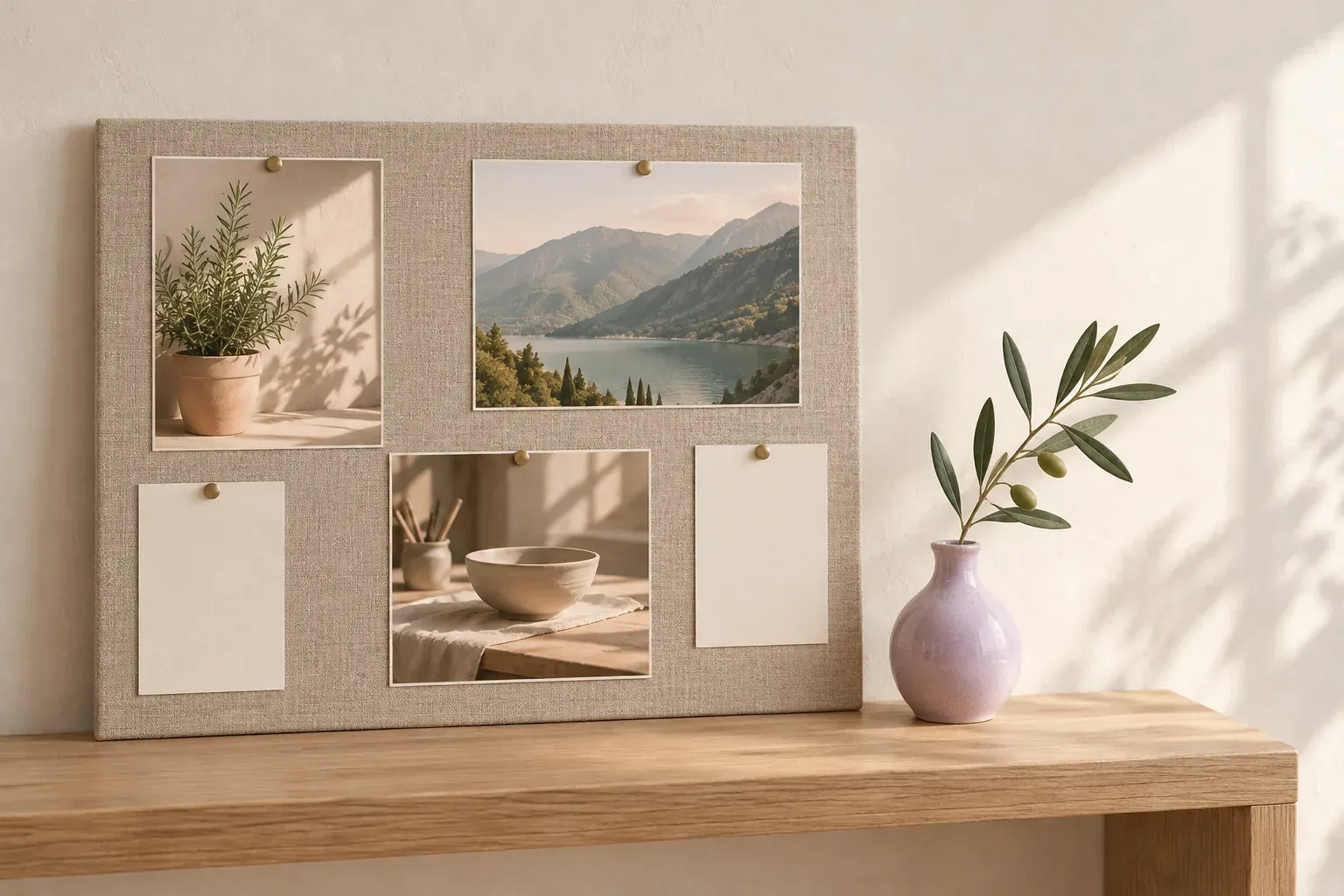
A vision board is a collection of images and words representing experiences, priorities or goals you want to work toward. Also called a dream board, it can be physical or digital, broad or focused on one intention. Its practical role is to make those intentions visible for reflection and planning; the pictures themselves do not cause outcomes or replace action.
What is a vision board meant to do?
The defining feature is purpose, not the material. A corkboard of travel photographs, a page of handwritten intentions and an editable collection of images can all be vision boards when they represent what someone wants to make room for. A collection becomes more useful when the person can explain why each reference is there. Without that explanation, it may simply be a collage of attractive pictures.
Vision board meaning is often mixed with the idea of manifestation. You can use the format without believing that thoughts attract events or that a displayed image guarantees a result. A board cannot arrange time off, resolve a financial constraint or determine someone else’s behavior. It can give you a place to consider what matters and what is realistic to try.
For example, a photograph of a ceramics studio might mean wanting to take an introductory class, wanting a larger workspace or admiring a room’s colors. Only the first two are personal intentions; the third is design inspiration. A short note makes the interpretation visible. The same image can do different jobs on different boards.
A dream board does not have to describe a complete dream life. It can represent a modest intention such as having a place to read or spending an afternoon exploring somewhere nearby. Nor must every item be a measurable target. Curiosity can belong, provided you distinguish it from a commitment.
What goes on a vision board?
Include material that explains an intention, not merely material that looks aspirational. Your own photographs, sketches, objects and plain words can be more specific than a stranger’s finished lifestyle. A useful reference answers both “What am I drawn to?” and “What does that mean in my circumstances?” There is no required number of images or standard set of categories.
- Images of experiences
- A place you want to explore, a shared meal or a kind of creative activity. Describe the experience rather than assuming an expensive object represents it.
- Images of process
- Tools, unfinished work, an accessible work surface or a notebook in use. These can show what participating might look like, rather than only the polished result.
- Words that clarify
- Short original notes such as “learn enough to repair this” or “make room for a quiet evening.” They explain the image without promising a transformation.
- Practical context
- A question about access, time, cost or permission. This can sit in a separate private note when it would make the display too crowded.
- A possible next step
- A small action you can choose: research, measure, ask, practice or compare. A larger hoped-for outcome remains uncertain even when you take that step.
Use the vision board ideas collection for specific references across work, creative practice, home, travel and community. Leave out another person’s priorities, sensitive details you do not want displayed and comparisons that make the board feel like a list of shortcomings.
Five types of vision boards
Choose a format according to where you will use it and how often its contents may change. Physical and digital are ways of storing the board; word-based and single-goal describe its contents; shared describes who participates. These categories can overlap. A family could make a digital, word-based board about one shared trip.
- Physical vision board
- A pinboard, scrapbook page or poster with images and notes. It can hold tactile pieces and remain visible without opening an app. Consider where private notes will be seen and whether you can rearrange the contents.
- Digital vision board
- An editable collection on a computer or other device. Images can sit beside notes and source links. Choose a layout you can revise, and check access settings before placing private intentions in it.
- Word-based vision board
- A small collection of intentions, questions or original phrases with few or no photographs. This suits goals that are hard to represent visually or people who find images ambiguous.
- Single-goal vision board
- One intention viewed from several angles: why it matters, what doing it involves and what is still uncertain. A project, a home change or a journey can have its own focused board.
- Shared or family vision board
- A collection built around agreed possibilities rather than one person’s wishes imposed on everyone. Keep individual choices visible, ask before adding personal material and leave room for disagreement.
A yearly or seasonal board adds a time frame to any of these formats. Treat the time frame as a review boundary, not a demand that everything happen by its end. Revising a board after circumstances change is part of using it, not evidence that you failed to believe in it strongly enough.
Vision board vs mood board vs goal list
These formats can contain the same photographs but answer different questions. Before choosing one, identify whether you are exploring a personal intention, specifying a visual direction or tracking actions. You can use more than one, as long as each has a clear job.
- Vision board: what do I want to work toward?
- A photograph of a garden might stand for learning to grow herbs. The central question is personal meaning and possibility, not how a finished design must look.
- Mood board: what should this look and feel like?
- That garden photograph might guide the colors, looseness and textures of a room or event. The board supports a creative decision rather than a life goal.
- Goal list: what am I choosing to do?
- The same intention becomes “check balcony light” and “compare suitable containers.” A list is clearer for explicit actions, dates and progress; it may omit the visual context that explains the intention.
The mood board definition explains the project-focused format, while mood board synonyms helps distinguish related labels. Calling a goal collage a mood board does not change its purpose; explaining what decision it serves does.
Keep a list when the priority is executing a known task. Use a vision board when you are still deciding what deserves attention or want visual context beside the tasks. If images distract you or add pressure, the plain list is a valid choice. You are not missing a necessary ingredient for achieving a goal.
Do vision boards work? Separate the board from the research
A useful standard is modest: does the board help you explain a priority, notice a constraint or choose a next action? That is different from claiming that looking at desired outcomes makes them happen. Research about a specific planning strategy should not be presented as proof that a collage, daily viewing or manifestation produces success.
Researchers Gabriele Oettingen and Peter M. Gollwitzer have studied mental contrasting and implementation intentions. A coauthored research paper hosted by NYU describes mental contrasting as considering a desired future and then the present obstacles to it. Implementation intentions specify an if–then link between a situation and a response. Those are structured thinking and planning procedures, not simply collections of positive images.
In that study, sixth- and seventh-grade students, both at risk and not at risk for ADHD, received either a learning-style intervention alone or that intervention plus mental contrasting with implementation intentions. The authors reported better parent-rated self-regulation of school-related goals in the combined condition at a two-week follow-up. The outcome was a parent rating in a particular educational setting; the study did not test vision boards or show that decorative imagery causes life goals to be attained.
For a board, a cautious practical adaptation is to write down a real obstacle and a chosen response beside an intention. An original example is “If the table is occupied when I want to sketch, then I will use the small clipboard.” This is an illustrative planning note, not a tested vision-board intervention. External barriers may need resources, assistance or a revised goal rather than a more positive attitude.
Do not treat a board as therapy, medical care or a financial strategy. It cannot promise health, wealth or relationship outcomes. If it creates pressure or stops being useful, change it, put it away or use another planning format.
How to make a small first vision board
Begin with one intention and a small enough scope that you can explain it. This quick start is for choosing the contents; it does not require a special layout, a purchase or an elaborate ritual.
- Name an experience or priority you want to explore during a chosen period.
- Choose a few personal or appropriately licensed references and explain what each means.
- Write one practical question or obstacle and one action you can choose.
- Keep the board somewhere appropriate for its privacy, then review it when the intention or your circumstances change.
For the complete editable structure, category choices and arrangement steps, use the digital vision board tutorial. For a place-focused intention, the trip planning template gives booking information and practical questions their own space instead of burying them in an inspiration collage.
How people use a board after making it
You can use the board during an occasional check-in, while considering a new opportunity or before choosing what to work on next. Ask whether the images still represent your priorities and whether a small experiment taught you anything. Looking at it daily is not a requirement, and there is no reason to turn each reference into an urgent deadline.
Keep sensitive context separate from a public display: a hoped-for career change, details of care or another person’s photograph may need a private note. Check permission before sharing other people’s work. For a shared board, decide together what can be shown and do not interpret another person’s image as a commitment they have not made.
In Canvas Perch, images, notes, links and files can sit side by side on an infinite canvas, with checklists and personal reminders nearby. The reminders and calendar documentation explains explicit time zones; a reminder can hold a chosen review or action without turning the board into a promise of results.
A useful review may end with removing something. You may discover that you liked the photograph but not the activity, or that a priority no longer fits your circumstances. The board is allowed to become smaller. Its value is in helping you think, not in proving that every pictured future came true.
Questions and answers
What is a vision board in simple terms?
It is a collection of images and words showing experiences or priorities you want to work toward. It can help you reflect and plan, but the images do not guarantee that the goals will happen.
Is a vision board the same as a dream board?
The names are often used for the same personal aspiration format. Make either useful by explaining the references and distinguishing hopes from actions you can choose.
What is the difference between a vision board and a mood board?
A vision board represents a future experience or personal priority. A mood board establishes the look and feeling of a creative project. The same image can serve either purpose, depending on why you include it.
Can a vision board be just words?
Yes. Short intentions, questions and original notes can form a word-based board. Use images only when they explain something more clearly than words alone.
Is there scientific proof that vision boards manifest goals?
The mental-contrasting and implementation-intention study discussed here tested structured planning, not vision boards or manifestation. It should not be used to claim that a collage causes outcomes.