Short answer
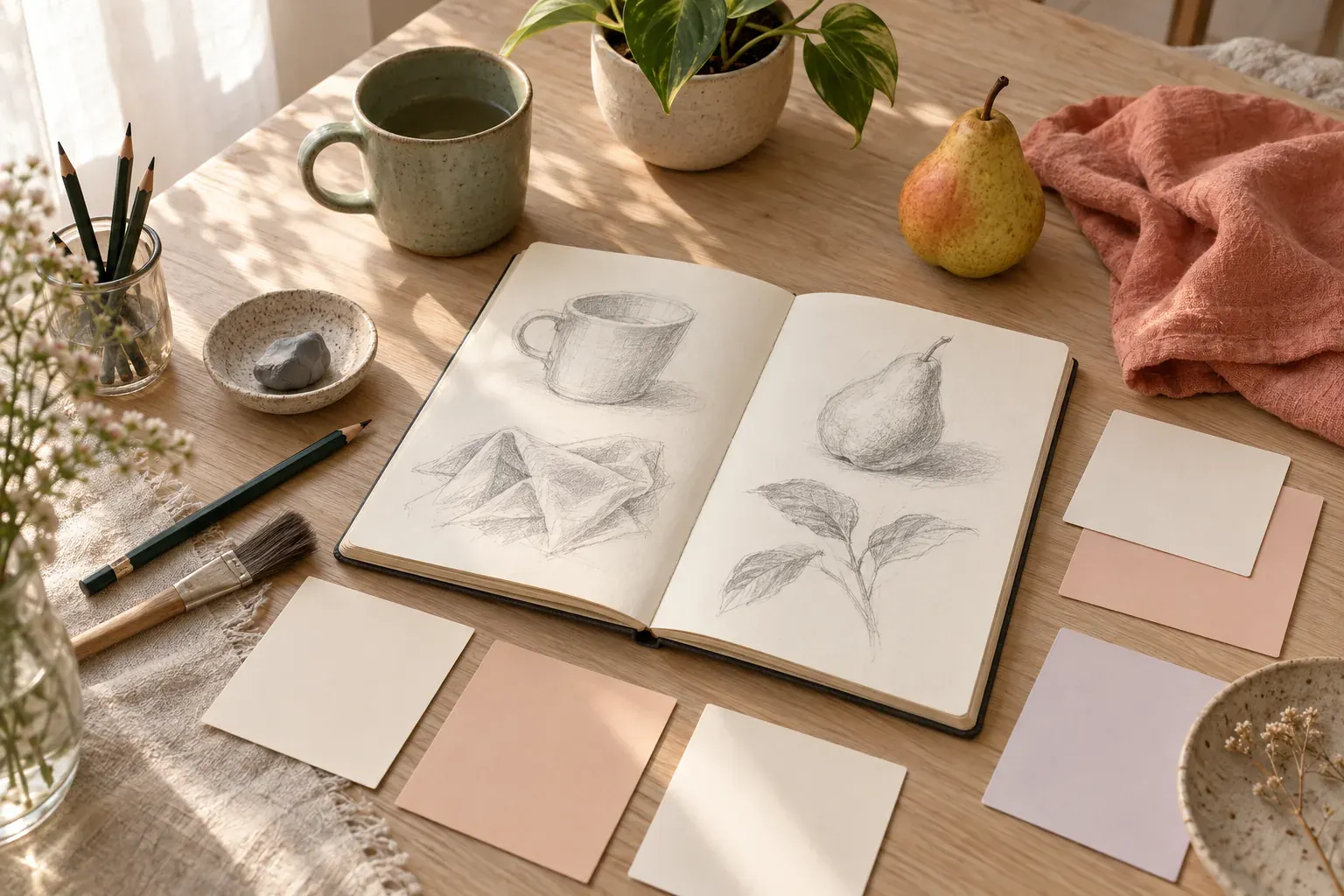
Good things to draw include objects you can observe closely, places you know and imagined subjects with a clear constraint. Choose one subject, one skill and a time limit rather than waiting for a perfect idea. These 98 drawing ideas pair specific subjects with line, value, perspective, texture or composition practice, in sessions of 5, 20 or 60-plus minutes.
Choose things to draw by time and skill
A cup becomes a different exercise when you draw its silhouette, shadow, rim or several arrangements on the page. Use the labels below as suggested session budgets, not promises about finishing. A five-minute drawing can be a thumbnail; a longer version can revisit the subject more closely.
- 5 minutes: make one small study with a single question. Stop before polishing and note what you observed.
- 20 minutes: compare large shapes, develop one area and leave a minute to identify the next correction.
- 60+ minutes: set up a subject, try several compositions, then develop one with a deliberate stopping point.
- Line: practice edges, directional marks and spaces between shapes. Leave shading for another exercise.
- Value: compare light and dark shapes using a few tones before attempting subtle transitions.
- Perspective: examine forms in space. Texture: distinguish surfaces with marks. Composition: arrange subjects and empty areas.
Start with a subject already within reach. If choosing itself has become difficult, the guide to art block offers smaller entry points. If you need fresh source material rather than another prompt, use art inspiration to gather it with a purpose.
Drawing ideas from objects at home
Set up these subjects where you can return to them. Keep the lamp or window relationship steady during a value study, and choose objects without complicated decoration when you want to concentrate on shape. You can use the same ordinary object throughout a week without producing the same drawing twice.
- 5 min · line — Draw a ceramic cup from above, concentrating on the opening and handle. Leave every surface unshaded so the curves carry the study.
- 5 min · composition — Arrange three keys in overlapping positions. Draw only their silhouettes and the gaps between them, then try a second arrangement beside the first.
- 5 min · texture — Study the end of a wooden spoon. Use a few directional marks for the grain rather than outlining every visible streak.
- 5 min · line — Draw the crumpled edge of a paper bag as one continuous path. Include the angular folds but ignore printed packaging details.
- 20 min · value — Put a pear beside a plain cup under one light. Group their shadow sides together before adding the smaller differences in tone.
- 20 min · perspective — Draw an open empty box with its flaps raised. Compare the directions of the edges instead of inventing an elaborate room around it.
- 20 min · texture — Place a knitted sock beside a metal spoon. Find a distinct mark vocabulary for each without covering both in identical crosshatching.
- 20 min · line — Draw a shoe with the laces loosened. Follow the path of each lace and leave the sole as a simple supporting shape.
- 20 min · value — Fold a dishcloth into three broad ridges. Draw the largest dark shapes first, leaving the lightest paper areas untouched until the end.
- 20 min · composition — Place a plant, cup and book on a shelf. Make four small crops that change which object becomes the main focus.
- 60+ min · perspective — Draw an open drawer containing four recognizable objects. Establish the drawer as a box before placing the objects within its space.
- 60+ min · value — Study a clear glass on a light tablecloth. Choose a few strong dark and light shapes rather than outlining every reflection.
- 60+ min · texture — Draw a worn chair seat beside its wooden frame. Compare fabric wear, seams and wood grain with carefully selected marks.
- 60+ min · composition — Build a still life from a pitcher, fruit and folded cloth. Test three thumbnails, then develop the arrangement with the clearest focal area.
Nature prompts you can observe nearby
Use a houseplant, a view from a window or objects you can observe without disturbing a habitat. Do not collect protected plants or remove animals for a drawing. A fallen leaf can support several studies: its outline, branching veins, curled form and changing shadow are separate questions.
- 5 min · line — Draw a single curled leaf from the side. Emphasize where its edge turns away and where the underside becomes visible.
- 5 min · composition — Sketch three stones in a shallow triangle. Change their spacing on a second thumbnail without adding surface detail to either drawing.
- 5 min · texture — Study one small patch of tree bark. Select a few cracks and ridges rather than trying to document the whole trunk.
- 5 min · line — Draw the branching pattern of a houseplant stem. Ignore individual leaves until the direction and spacing of the branches read clearly.
- 20 min · value — Put a pinecone beside a smooth stone. Establish their shared shadow first, then separate their different surface rhythms with selected dark marks.
- 20 min · perspective — Draw a flowerpot and its saucer at table height. Compare the visible openings before adding a plant or decorative pattern.
- 20 min · texture — Draw a citrus peel beside a cut slice from your own fruit. Contrast the pitted outer skin with the segmented interior.
- 20 min · composition — Make four window-view thumbnails during cloudy weather. Use the same tree as a focal shape in each, with different amounts of sky.
- 20 min · line — Follow the outline of a tangled root or fallen twig. Preserve its unexpected changes of direction rather than smoothing it into symmetry.
- 20 min · value — Draw a broad leaf with light coming through it. Separate its overall silhouette from the darker veins and the stem shadow.
- 60+ min · texture — Study a weathered stump from a safe path or your own photograph. Choose one focal section for detail and simplify the surrounding ground.
- 60+ min · composition — Design a page of botanical studies from one plant: whole silhouette, leaf close-up, stem junction and a small value thumbnail.
- 60+ min · value — Draw the same outdoor view in three simplified tonal arrangements. Keep the main land shapes constant while changing the balance of light and dark.
- 60+ min · perspective — Draw a cluster of overlapping flowerpots outdoors. Use their rims, bases and cast shadows to describe their relative positions on the ground.
Places and architecture to draw
Choose a safe place to sit or work from photographs you took yourself. You can simplify signs into blank shapes and leave strangers out of the scene. Begin with the large structure: an attractive door handle cannot fix a doorway whose overall shape has not yet been considered.
- 5 min · line — Draw your doorway as a group of nested rectangles. Notice which edges are actually visible rather than adding details from memory.
- 5 min · composition — Sketch a street corner in three postage-stamp thumbnails. Give each a different focal shape: a roof, a tree or a bright doorway.
- 5 min · value — Draw the shadow under a porch or awning as one dark shape. Leave the rest of the building mostly white.
- 5 min · texture — Study one patch of brickwork, including a chipped edge. Suggest the wall with selected joints instead of tracing every brick.
- 20 min · perspective — Draw a hallway from your own doorway. Compare floor, ceiling and wall edge directions before adding the furniture at the far end.
- 20 min · line — Draw a balcony railing and the empty spaces inside it. Keep the rhythm of the gaps more important than decorative metalwork.
- 20 min · composition — Crop your kitchen into a drawing containing only the sink, window and one object. Make the unused space part of the arrangement.
- 20 min · value — Draw a staircase as alternating light and dark shapes. Add only enough edges to make the sequence of steps understandable.
- 20 min · texture — Study a weathered gate from a permitted public viewpoint. Contrast peeling paint with the smoother latch and surrounding wall.
- 20 min · perspective — Draw a park bench from an angle using your own photo. Establish the seat and back as broad planes before describing individual slats.
- 60+ min · composition — Draw a familiar storefront without lettering. Use the window shapes, doorway and surrounding pavement to establish its character and focus.
- 60+ min · perspective — Draw a room corner containing a chair and lamp. Start with the walls and floor, then check how the objects occupy that space.
- 60+ min · value — Study an exterior wall with a tree shadow across it. Simplify the building details so the shadow pattern remains the main subject.
- 60+ min · line — Make a local-place study sheet: one overall building view, one roof detail and one doorway detail, using your own photographs or observation.
Animals without chasing a perfect pose
Observe animals without disturbing them. For a moving subject, several partial drawings can be more useful than one repeatedly corrected pose. Use your own animal photographs or references explicitly licensed for your intended use when you need a still image; save the source and permission information with it.
- 5 min · line — Sketch a sleeping pet as one large curved shape. Add only the head direction and the position of the tucked paws.
- 5 min · composition — Draw three tiny silhouettes of a bird on a railing. Change the bird’s placement inside each rectangle without inventing feather details.
- 5 min · line — From your own photograph, draw the sweep of a cat’s tail and back. Let those directions organize the rest of the pose.
- 5 min · texture — Study a small patch of fur from a licensed close-up. Group it into tufts rather than trying to count separate hairs.
- 20 min · value — Draw a dark animal against a light background from your own photo. Separate the silhouette from just two or three internal light shapes.
- 20 min · line — Make a page of duck head shapes from safe observation. Notice the changing angle between the bill and the rounded head.
- 20 min · perspective — Draw a pet curled in a basket. Block in the basket opening first, then place the animal’s broad form inside it.
- 20 min · texture — Compare a feather and a smooth eggshell from permitted household materials. Use different marks while keeping the overall lighting consistent.
- 20 min · composition — Draw a fish from an appropriately licensed photograph in three different crops. Keep its body shape unchanged while varying the surrounding water space.
- 20 min · line — Study a dog’s seated pose from your own photograph. Compare the slope of the back with the direction of the front legs.
- 60+ min · value — Draw a resting animal with one clear light source from your own reference. Develop the head and simplify less important fur elsewhere.
- 60+ min · composition — Create a study sheet of one animal in three poses using licensed references. Keep source notes separate from your observations about its shape.
- 60+ min · texture — Draw a shell from several angles. Use its ridges to describe the changing surface rather than filling the page with decorative stripes.
- 60+ min · perspective — Draw a toy animal beside its packaging box. Treat both as objects in the same space, not as a wildlife anatomy exercise.
Figure ideas using yourself or a mannequin
You do not need photographs of strangers to practice figures. Use a mirror, your own consenting self-portraits or an artist’s mannequin. A mannequin is a pose aid, not a replacement for studying the forms of a real body. For short movement studies, gesture drawing explains how to prioritize the whole pose over small features.
- 5 min · line — Observe your relaxed hand on the table. Draw the overall shape and the spaces between fingers without adding nails or wrinkles.
- 5 min · line — Pose a wooden mannequin leaning to one side. Draw one main sweep through the body and the opposing directions of its limbs.
- 5 min · composition — Draw your reflected head as a silhouette in three small rectangles. Change the crop rather than attempting three finished portraits.
- 5 min · value — Sketch your own shoe and ankle from observation as three tonal groups. Keep clothing details subordinate to the broad light pattern.
- 20 min · line — Draw your hand loosely holding a plain cup. Compare the cup opening with the negative spaces between your fingers and its handle.
- 20 min · perspective — Place a mannequin seated on a small box. Establish the box planes before locating the simplified pelvis, torso and legs.
- 20 min · value — Study your face in a mirror with comfortable side lighting. Group the shadow areas and postpone individual eyelashes or hair strands.
- 20 min · texture — Draw a sleeve draped over your own forearm. Let the largest fabric folds describe the position before adding seams or weave.
- 20 min · composition — Make four thumbnails of a mannequin reaching toward an object. Change the framing while preserving the relationship between the pose and target.
- 20 min · line — Draw your reflection sitting on a chair. Begin with shoulder and hip directions, then add the chair as a supporting structure.
- 60+ min · perspective — Draw a mannequin with one limb pointing toward you. Compare the visible overlaps and apparent lengths instead of stretching the limb sideways.
- 60+ min · value — Develop a self-portrait from your own photograph with clear lighting. Plan the large tones first and select one focal area to refine.
- 60+ min · composition — Create a three-panel self-observation sequence: sitting, standing and reaching. Use your own photos, and keep the setting simple across the sequence.
- 60+ min · texture — Draw a coat on a mannequin or chair back. Study how its thick folds differ from a thin scarf placed beside it.
Imagination prompts with useful constraints
An invented subject is easier to start when you specify its job, setting or construction. Borrow observations of your own objects for believable details, but do not require the drawing to become realistic. These prompts are original starting points; change them freely rather than treating their instructions as a test.
- 5 min · line — Invent a teapot shaped like a curled leaf. Keep the spout, handle and opening recognizable with as few outlines as possible.
- 5 min · composition — Draw a tiny island containing one tree and one staircase. Test how the empty water changes the feeling of the scene.
- 5 min · texture — Invent three surfaces for a moon rock: glassy, porous and layered. Give each a different set of marks without changing its outline.
- 5 min · line — Design a creature using a pear-shaped body and twig-shaped limbs. Draw three poses rather than decorating a single static silhouette.
- 20 min · perspective — Draw a small library inside an oversized cup. Use the cup’s opening and walls to organize the invented shelves and ladder.
- 20 min · value — Invent a lantern-lit garden gate. Limit the drawing to paper white, one middle tone and one dark so the lighting stays readable.
- 20 min · composition — Draw a delivery bicycle carrying an impossibly tall stack of plants. Use a simple background to make the balancing problem clear.
- 20 min · texture — Invent a shelter made of fabric, stone and woven branches. Choose separate marks for each material and repeat them consistently.
- 20 min · line — Draw a mechanical bird built from kitchen tools you own. Preserve recognizable tool shapes while changing their function within the invented body.
- 20 min · perspective — Design a room with a staircase leading through a circular window. Sketch the room structure before adding small narrative objects.
- 60+ min · composition — Draw a quiet market for invented weather instruments. Develop three stall thumbnails, then choose one arrangement with a clear route through it.
- 60+ min · value — Imagine a lighthouse inside a forest. Plan where its beam falls and keep the surrounding trees grouped into readable dark shapes.
- 60+ min · texture — Design a traveling greenhouse with patched canvas walls, wooden wheels and glass panels. Make its material differences visible without labeling them.
- 60+ min · perspective — Draw a cutaway of a tiny workshop inside a tree stump. Decide which wall is removed before placing tools and furniture.
Design exercises when you do not want a scene
These exercises turn drawing into a series of choices rather than a search for a new subject. They are useful when you want to practice arrangement or shape without making a detailed illustration. Keep variants on the same page so you can compare the decisions instead of relying on memory.
- 5 min · line — Draw six cup silhouettes, each with a different handle. Keep the body identical so you can compare the handles without other distractions.
- 5 min · composition — Arrange five black shapes inside a square. Make a second version that changes only their spacing, then compare the focal point.
- 5 min · texture — Fill three small boxes with marks suggesting cloth, wood and stone. Use one drawing tool so the distinction comes from your marks.
- 5 min · value — Make three tiny landscapes using only light, middle and dark bands. Change the band proportions rather than adding buildings or trees.
- 20 min · line — Design a family of six original plant labels without lettering. Give each a recognizable plant silhouette and a consistent outer shape.
- 20 min · composition — Invent four covers for a wordless garden notebook. Reuse the same leaf, pot and circle shapes in every arrangement.
- 20 min · perspective — Design three small storage boxes with different openings. Draw each from the same angle so their construction remains easy to compare.
- 20 min · texture — Create a repeat pattern from a leaf you observed yourself. Test both dense and sparse spacing without tracing someone else’s pattern.
- 20 min · value — Draw one still life in four tonal versions. Change which object receives the strongest contrast while keeping the outlines consistent.
- 20 min · line — Create a wordless instruction strip showing how to fold a cloth. Use your own observation and distinguish each stage with clear object shapes.
- 60+ min · composition — Design a set of three original travel postcards for your neighborhood. Use your own place studies and a shared arrangement principle.
- 60+ min · perspective — Invent a compact desk organizer for objects you own. Draw an overall view plus a close-up showing how one compartment works.
- 60+ min · texture — Build a monochrome pattern collection from household surfaces. Develop three related designs while preserving a distinct mark vocabulary for each.
- 60+ min · composition — Turn one nature study into a six-image series. Keep the subject constant and vary crop, scale, empty space and tonal emphasis.
Turn a prompt list into a practice board
Choose three prompts for the week: an easy start, a focused study and a longer experiment. Record the subject, time, skill and stopping rule. A fictional brief might read: “Pear and cup; 20 minutes; value; stop after three clear tonal groups.”
- First session: observe the chosen subject and make a short study. Note one relationship you missed, such as the handle’s angle or the shadow’s width.
- Second session: repeat the subject with the same skill focus and one deliberate change. Compare the drawings side by side without demanding that every feature improve.
- Third session: apply the observation to another subject. If you practiced cloth shadows, try a folded sleeve rather than changing immediately to a complicated cityscape.
- Weekly review: keep one study, identify one useful correction and choose the next three prompts. A missed session does not create a debt of extra drawings.
Build a reference board for drawing with separate areas for upcoming prompts, source material and completed studies. Record a reference’s creator, original URL and permission or public-domain status. Prefer your own photographs or clearly licensed material; a repost or a credit line alone does not establish permission to reuse someone else’s work. The U.S. Copyright Office’s guidance also makes clear that there is no fixed percentage change that automatically makes a new version yours.
Canvas Perch’s infinite canvas lets images, notes, links and files sit side by side, with connections and checklists nearby. Use one frame for this week’s selected prompts and a note beside each study for the next question. A small, purposeful board matters more than collecting every possible subject.
Repeat a useful prompt from another angle or with another tool. Simplify one that does not work. The aim is not to complete all 98 items, but to make the next drawing specific enough to start and focused enough to learn from.
Questions and answers
What should I draw when I have no ideas?
Choose one object within reach, such as a cup, shoe or leaf, and draw it for five minutes with one focus: outline, shadow or texture. A specific observation is a more usable starting point than searching for a completely original subject.
What are easy things to draw for beginners?
Start with a plain cup, a pear, a closed book, a flowerpot or a folded cloth. Use one object and clear lighting, and simplify decoration. Easy means a manageable drawing question, not that the subject cannot support advanced work.
What can I draw in five minutes?
Draw a leaf outline, a key silhouette, a sleeping pet’s broad shape or three small composition thumbnails. Choose a single skill and stop at the time limit; the result can be a useful study without becoming a finished illustration.
How do I turn drawing ideas into a routine?
Choose three prompts for a week, pair each with a time budget and skill focus, and repeat one subject before moving on. Keep a brief note about what you observed and use it to choose the next exercise.
Is it better to draw from imagination or reference?
Use observation or reference when you want to examine real shapes, lighting and surfaces. Use imagination when you want to invent or rearrange them. You can combine both by observing a real object and using its structure in an original invented scene.