Short answer
Art inspiration can come from museum collections, everyday objects, nature, local places and other art forms. Start by noticing a specific quality—shape, light, rhythm, material or atmosphere—rather than collecting images you simply like. Record the source and your observation, then turn it into a small project brief with a subject, format, constraint and first study to make.
Where to find art inspiration with a purpose
Look for input that answers a question you want to explore. “How can I draw a quiet room without showing a person?” gives you reasons to notice empty chairs, window light, fabric and objects left on a table. “Find beautiful pictures” can produce a large collection without a next action. Both browsing and making can be enjoyable, but they are not the same task.
- Subject
- Something you could depict: a local doorway, a bowl of fruit, a leaf or an invented place. It answers what the work might contain.
- Visual quality
- A feature you could investigate: interrupted lines, close tonal values, a repeating curve or a large area of empty space.
- Idea
- A relationship or question you could develop: a familiar object placed in an unfamiliar setting, or a sequence showing changes in one place.
- Project brief
- A small set of decisions that makes the inspiration usable: the output, subject, format, constraints and first experiment.
You can start without a defined personal style. If aesthetic labels help describe an atmosphere, the guide to types of aesthetics offers vocabulary, not a requirement to fit your work into a category. Translate a label into visible choices such as muted colors, irregular edges or a sparse arrangement before making it a project direction.
Museum collections with verified open-access images
A museum collection is useful for comparing different solutions to the same visual problem. Search for a subject you already understand, such as cups, trees or interiors, and examine how several artists arrange it. Select a few works with a reason for each. Do not assume that everything visible on a museum website is available for unrestricted reuse.
- The Metropolitan Museum of Art: its Open Access initiative makes images of public-domain artworks available for unrestricted use under Creative Commons Zero, or CC0. Check the particular artwork and image’s open-access status rather than applying that policy to every image on the site.
- The Art Institute of Chicago: its Open Access Images guidance explains how to find public-domain images and identifies images offered under the CC0 designation. The museum requests a caption with artist, title, date and museum, and notes that users remain responsible for necessary third-party permissions.
As of October 2026, these published policies provide useful starting points, not blanket permission for every collection item or every context. Keep a link to the object page and its rights statement alongside the downloaded image. An institution can hold both public-domain works and copyrighted works; the collection’s name alone does not resolve a particular image’s status.
Try a focused comparison: choose three appropriately sourced still lifes and sketch their largest shapes as tiny thumbnails. Compare where the main object sits, how much space surrounds it and which value receives the most emphasis. The useful takeaway might be a composition principle you can test with objects you own, rather than a painting to reproduce.
Libraries, archives and other art forms
At a library, choose a shelf outside your usual interests: gardening, architecture, textiles, geology or local history. Look for structures and observations rather than treating every page as a source image to reproduce. Record the book’s creator, title and relevant page so you can return to the context. Access through a library does not mean the contents are public domain or licensed for reuse.
- A textile book: notice how a border changes the center of a pattern. Design an original border using a plant you observed yourself.
- An architecture book: compare three entrances and sketch their broad proportions. Develop an invented entrance rather than tracing a published photograph.
- A local-history collection: use an old view to ask how a place has changed. Make your own current photographs and check archival rights before using the original image.
- Music: translate a recurring rhythm into an original sequence of marks or shapes. You can respond to pace without copying lyrics, artwork or notation.
- Literature or film: write your own description of a spatial relationship or atmosphere, then draw a different subject that explores it. Avoid relying on copied dialogue or frames as decoration.
Crossing between art forms can produce a practical constraint. A repeated musical phrase might become a drawing series with one constant shape and one changing element. A passage about a narrow room might lead you to observe your own hallway. Label the source of the initial thought while distinguishing it from the original material you are making.
Nature, everyday objects and local places
You do not need travel to find a subject you have not really observed. Choose one familiar route and look for a specific quality: shadows across doorways, worn edges, repeating windows or plants growing around a fence. A travel sketch can be valuable, but so can three views of the same corner near home. Work from a safe place and respect local rules about access and photography.
- Nature: observe a leaf from above and from the side. Use its changing silhouette as the starting point for a drawing or original pattern.
- Objects: place a cup beside a folded cloth and look for a relationship between rigid curves and irregular folds. Make a two-material study rather than a crowded still life.
- Local places: photograph or sketch one doorway at different times when permitted. Compare the changing light while keeping the architecture as a constant.
- Wear and repair: study a patched bag, chipped bowl or scuffed chair you own. Decide which marks explain its material and which you can leave out.
- Travel: make your own records of a place, with notes about the light and viewpoint. Avoid reducing a community or culture to a decorative stereotype.
- Temporary arrangements: draw the objects left after making tea or preparing a meal. Their overlaps can supply a composition you would not have planned deliberately.
Gather only what you can observe without disturbing wildlife or removing protected material. You can sketch a stone or leaf where it lies rather than bringing it home. If choosing a subject is the sticking point, things to draw organizes specific exercises by subject, time and skill so the observation has a manageable scope.
Collect inspiration without confusing study and copying
Keep three questions separate: what caught your attention, what you are making and what permission the source provides. An image may inspire a new observation without being something you should reproduce. A close copy can be a useful study when the source allows it and the result is labeled honestly. Neither an attractive board nor a source credit resolves rights by itself.
- Record provenance: creator, work title, institution or original publisher, original URL and the item-specific rights statement or license.
- Write the observation: describe one useful quality in your own words, such as “small dark object surrounded by a large pale surface.”
- Name the intended use: private study, shared study, collage, illustration or another output. Check whether the source terms cover that use.
- Separate study from original work: label a close study as after the artist and identify the source. Do not present it as an independent original composition.
- Use your own material for the new project: observe your own subject and develop your own arrangement. Keep a note explaining what you learned from the source.
“Transform the idea” is creative advice, not a legal safe harbor. The U.S. Copyright Office’s FAQ explains that there is no fixed amount of change that gives you a claim to someone else’s work, and that fair use depends on the circumstances. When a project requires an existing image, use material you own, a suitable explicit license or a verified public-domain source. This guide is not legal advice.
For example, a public-domain landscape might lead you to notice a low horizon and a large sky. You can test that relationship in a drawing of a local field from your own observation. That is a clearer project decision than copying the original hills and changing only the colors while calling the result new.
Build an inspiration board that leads to work
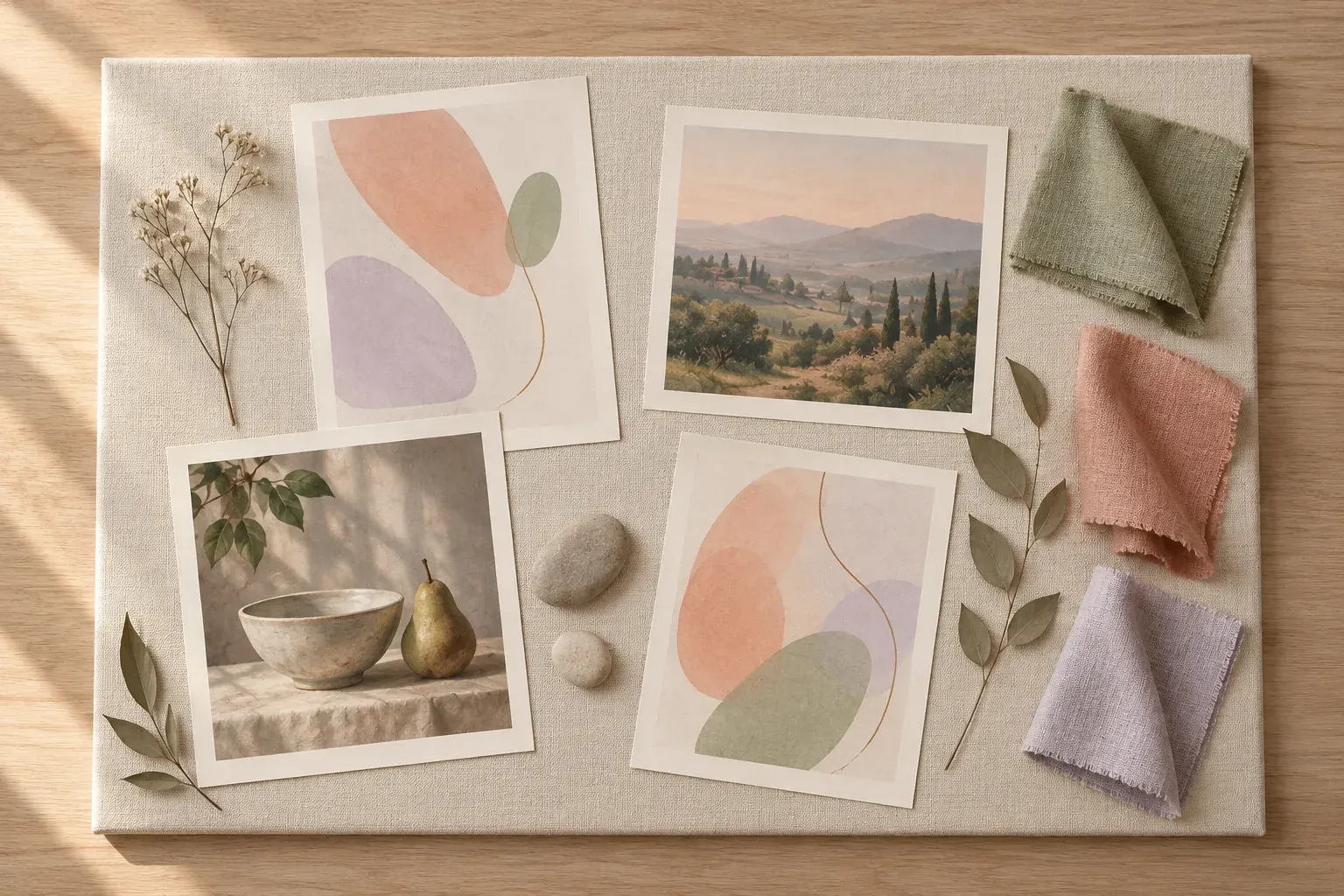
A useful board needs a question, a small selection and an exit into making. A mood board can define the atmosphere of a project; a reference board for drawing can organize the specific source material needed to draw it. Choose the structure that serves your next decision rather than combining every saved image into one wall.
- Question: write the visual problem at the top, such as “How can an empty kitchen feel inhabited?”
- Inputs: keep a small group of sources, with an observation and provenance beside each. Include your own material as well as permitted outside references.
- Patterns: note relationships you notice across inputs, such as repeated curves, soft edges or unusually large empty areas.
- Decisions: state which qualities you will actually test and which attractive detours belong to another project.
- First studies: place three thumbnails or material tests beside the selected sources. The board now contains responses, not just inputs.
Canvas Perch’s capture workflow lets you collect notes, safe web links, images and documents in an inbox before deciding where they belong. Its infinite canvas supports keeping images, notes, links and files side by side, with connections and checklists nearby. Keep source information with your material and choose a small set for the current project.
If you are considering a different place to collect material, Pinterest alternatives compares options by what you want to do with the collection. The most important test is whether you can find a source, explain why you saved it and turn it into a decision—not how many pictures the tool can hold.
Turn inspiration into a small project brief
A project brief turns an attractive possibility into a task you can begin. Keep it short enough to read beside the drawing surface. Choose an output you can finish with your available time and materials. The brief can change after a study, but it should give you a meaningful first comparison rather than simply asking for something beautiful.
- Output: one postcard-sized drawing, a three-image series or a page of studies.
- Subject: the object, place or invented scenario you will actually depict.
- Visual intention: one relationship to emphasize, such as a small dark shape inside a broad light field.
- Constraints: a limited tool set, a fixed format, a small number of tones or a consistent viewpoint.
- Sources: your own observation and any permitted references, with credit and rights information.
- First experiment and finish rule: the smallest study that tests the intention, and the conditions that will make the selected work complete.
Here is a fictional brief: “Make three small graphite drawings of my kitchen after breakfast. Use my own observations, three tonal groups and the same rectangular format. Leave people out; suggest use through a cup, folded cloth and open chair space. Start with three thumbnails, choose the clearest arrangement and stop when the focal object and supporting shapes are readable.” Every saved image can now be judged against a task.
When the studies disagree with the board, update the brief rather than forcing the drawing to match a collage. A delicate palette might not supply enough contrast for the arrangement you chose; a complex crop might hide the object that mattered. Those are useful decisions from making. The references have done their job when you can work without consulting every one of them.
What to do when collecting replaces creating
Try a deliberate handoff: choose three sources, write one sentence about each and make one small response before adding another image. A response can be a shape thumbnail, value test or observation drawing. If it reveals a missing reference, look for that particular reference rather than restarting an unrestricted search.
If nothing in the collection feels usable, the problem may be an unclear task rather than too little inspiration. Choose a familiar subject and one constraint, or take a break if you are depleted. The guide to art block separates starting, developing and finishing difficulties. You do not need to turn every encounter with art into a project; a collection can also be something you simply enjoy.
Questions and answers
Where can I find art inspiration?
Look in museum collections, libraries, nature, everyday objects, local places and other art forms. Choose one specific quality to observe, then make a small study that tests it instead of only collecting appealing images.
How do I get art ideas from everyday life?
Choose a familiar object or place and change the question: study its shadow, crop, surface, opening or relationship to another object. A narrow observation can become an original drawing brief without requiring an unusual subject.
Can I use museum images for my art?
Some museum images are offered under explicit open-access policies, including designated public-domain images from the Met and CC0 images from the Art Institute of Chicago. Check the particular item’s status and any relevant third-party permissions; a museum website is not entirely unrestricted.
How can I use inspiration without copying?
Identify the principle you notice, such as a low horizon or repeated curves, then test it with your own subject and arrangement. Credit the source and distinguish a close study from original work. If you need to reproduce source material, check permission rather than assuming alteration makes it lawful.
What should go on an art inspiration board?
Include a project question, a small set of sourced inputs, an observation beside each, selected visual decisions and your first studies. Add a short brief so the board leads to something you can actually make.