Short answer
Creative direction is the overarching concept, message and voice that connect a campaign, brand or body of work. It explains what the work should communicate, who it is for and how different outputs should feel related. Develop one by defining the purpose, choosing a coherent idea, showing its expression through references and sample work, and recording the boundaries that later decisions must respect.
What is creative direction?
Creative direction gives separate pieces a shared reason to exist. A campaign might include photographs, copy, a landing page and a short video; a personal project might include a zine, a photo series and a small exhibition. The direction connects them through an idea rather than merely applying the same colors to everything.
Prospects’ creative director profile describes creating, planning and delivering strategic vision, maintaining cohesive visual and thematic style, and guiding a creative team. The same broad questions are useful on a smaller scale: what are we saying, to whom, through which pieces and with what boundaries?
A usable direction can be expressed in a sentence and demonstrated through examples. “Show everyday making as a process worth noticing” is a possible concept. “Use cream, sage and serif type” is a collection of visual choices; it still needs an explanation of why those choices serve the concept. A long list of fashionable adjectives leaves that work undone.
For a small brand, connect the direction to the actual offer and audience context. For a personal project, define your intention honestly without inventing a client, research findings or business goal. A self-imposed creative constraint can be valuable, but it should not be presented as evidence that an audience wants something.
Creative director vs art director: separate the questions
A useful working distinction is that creative direction asks about the overall concept, message and voice, while art direction asks how that concept should be expressed visually. A creative director may guide work across writing, design and image-making. An art director may guide image selection, typography, layout and other visual decisions. The boundaries vary by organization and field.
The BLS Art Directors profile emphasizes visual style, selecting design elements, directing other makers and reviewing work. Prospects describes creative teams that can include art directors, copywriters and designers. These descriptions support the distinction without implying that every company follows an identical hierarchy.
- Overarching concept
- For a fictional gardening project: invite beginners to notice small changes in a container garden, rather than presenting a perfect finished space.
- Visual expression
- For that same concept: show real plants at several stages, ordinary containers, straightforward viewpoints and a restrained background.
- Written voice
- Use specific observations and inviting instructions, with uncertainty acknowledged; avoid dramatic promises or expert authority the project does not have.
- Individual execution
- Make a particular photograph, caption or page communicate its part clearly while retaining the shared concept.
If the concept is settled but the imagery is inconsistent, work on art direction. If the deliverables, scope or approval responsibilities are unclear, return to the design brief. A single person can own all these tasks while still separating the decisions.
What belongs in a creative direction document or deck?
Use a concise document or deck to make the proposed direction understandable without a live explanation. Start with purpose and concept, then show the choices they lead to. The outline below is a practical working template, not an industry-mandated format. Keep unresolved matters labeled instead of making the presentation look more final than it is.
- Project and purpose: [what you are making], [why it exists], [what it must communicate].
- Audience and context: [who it is for], [where they encounter it], [known information and assumptions to check].
- Concept: [one organizing idea], [why it fits the purpose], [what differentiates it from another possible approach].
- Message and voice: [main point], [supporting points], [tone], [words or claims to avoid].
- References and mood board: [selected sourced references], each with [the quality being studied rather than copied].
- Visual expression: [palette roles], [type character], [image approach], [layout or material cues].
- Deliverables and sample applications: [specific outputs], [contexts or formats], [original examples demonstrating the idea].
- Guardrails: [fixed requirements], [what must not change], [what the direction should not become].
- Review and decisions: [approver], [questions for feedback], [open tests], [version date], [next deliverable].
Do not let visual polish hide an unclear message. A palette can suggest the proposed atmosphere, but explain where colors will be used. Type samples can suggest the voice, but test actual headings and paragraphs. If a short video is included, describe what it should say and how it relates to the other pieces rather than adding an impressive reference reel with no rationale.
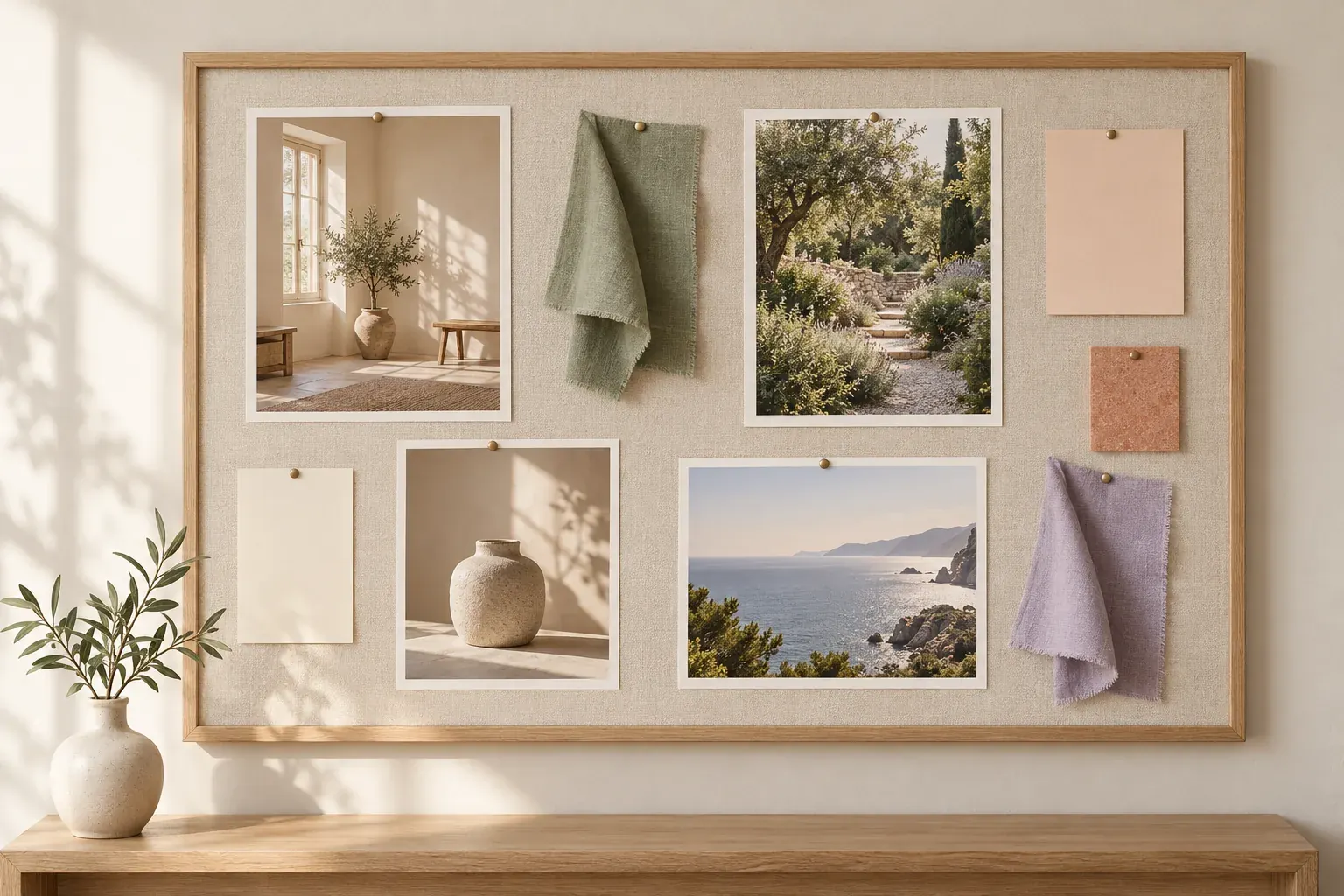
A brand mood board can support the visual part of the deck. Keep it distinct from the concept and written voice: a board of beautiful interiors cannot by itself explain the message, audience or deliverable boundaries.
Develop creative direction for a personal project or small brand
Start with the information you actually have. Name the offer or subject, the intended audience and the encounter you are designing for. If audience knowledge is thin, record that limitation and ask focused questions before treating a preference as a proven need. For personal work, a clear artistic intention is enough; invented market validation is not.
- Define the problem or intention in one sentence, without prescribing the look yet.
- Choose the main message and identify what a viewer needs to understand rather than a feeling you hope to cause.
- Develop two plausible concepts that answer the same brief in meaningfully different ways.
- Gather a small set of sourced references for each, annotating the relevant idea, voice or visual quality.
- Select a concept against the brief, resources and boundaries rather than by which collage is prettiest.
- Make one original sample with realistic content and review whether the concept survives outside the references.
- Record the approved direction, remaining questions and next production decision.
Keep concept development separate from final production. A reference for documentary photography does not prove you have access to the participants or location. A desired material does not prove it is available within your constraints. Let production tests change an impractical expression without losing the useful idea behind it.
For different ways to arrange exploratory material, see mood board examples. Limit the selected board to references you can explain. Keep an exploration area for appealing items that do not yet belong to the direction, so they do not silently become requirements.
A fictional example: a balcony-growing journal
This example is entirely fictional. Imagine a personal photo-and-writing project called Small growing days, documenting one container garden. It includes a short zine, six paired photographs and a simple project page. It is not an actual brand, gardening study or claim that the proposed direction would produce a measurable audience response.
- Purpose and audience
- Share close observations of a small growing space with people curious about an ordinary beginner’s practice. Treat this audience as an intention for the exercise, not a researched segment.
- Concept and message
- Small changes are worth recording. Show an unfinished process rather than hiding it behind a perfect final garden.
- Voice
- Plain, specific and observant: describe what was seen and done. Do not turn a personal observation into universal plant-care advice.
- Visual approach
- Repeat a few viewpoints, show plant and container details, retain ordinary surroundings and use a quiet page layout with room for dated notes.
- Guardrails
- No borrowed garden photos presented as personal work, no invented progress, no claims that a certain palette causes calm, and no private neighboring spaces in public images.
- First application
- Make one paired-photo spread with honest sample captions and one project-page section; check that both communicate the same concept without looking identical.
Suppose an early page uses only lush finished plants. It may look polished, but it contradicts the concept of observing a process. Add a real intermediate stage if one exists; if it does not, change the sequence or wait to collect it. Do not manufacture a false before-and-after merely to satisfy the deck.
The photographic expression can be planned using a few relevant photoshoot ideas, such as a repeated plant viewpoint or a material detail. The concept narrows which ideas belong: a dramatic fashion portrait might be compelling, but it has no clear role in this particular project.
Present the direction and ask for decision-making feedback
Lead with the brief and concept before showing the board. Explain the audience context, main message and why the selected approach fits. Then demonstrate one or two original applications. Showing the intention first helps reviewers discuss whether the proposal works for the assignment instead of reacting to isolated favorite colors or images.
- Does the concept answer the stated purpose, and which part of the proposal demonstrates that?
- Can someone explain the main message without relying on the presenter’s extra commentary?
- Do the visual and written choices reinforce the concept or suggest a different one?
- Which requirement is not yet demonstrated in an actual application?
- Is the proposed work feasible with the available time, materials, access and permissions?
- What exactly is approved now, and which questions still need a test?
Translate vague feedback into a decision you can act on. If someone says “make it more energetic,” ask whether they mean a faster sequence, shorter copy, more active subjects or stronger visual contrast. Those are different changes. If a suggestion alters the core message, discuss it as a concept change rather than quietly adjusting a few details.
Keep a named decision owner and collect conflicting feedback in one place. Do not settle a substantive contradiction by averaging it: a direction cannot simultaneously promise an immaculate finished result and document an uncertain process without explaining the relationship. Compare the alternatives against the brief, then record the selected answer.
Keep later work aligned with the approved concept
Turn the approved deck into a short working reference. Include the concept sentence, main message, voice, essential visual choices and guardrails. Retain representative examples that show the direction in use. The original exploration board can remain available, but it should not compete with the current decisions.
Review new pieces at natural checkpoints. Ask what role the piece plays, whether it communicates the shared idea and whether an exception is intentional. Variation is welcome when it serves the concept. Drift is an unexplained change that weakens the relationship between pieces. Not every output needs the same composition or length to belong to the same body of work.
- Message check: the piece says something consistent with the approved idea, without introducing unsupported promises.
- Voice check: the language follows the intended tone while remaining specific to this subject.
- Visual check: image treatment, palette roles and hierarchy follow the selected approach where applicable.
- Production check: access, assets and permissions are confirmed rather than inferred from a reference.
- Change check: a new requirement or concept revision is recorded with its effects on the other deliverables.
Keep a dated approved version and distinguish it from working notes. When the concept changes, update the summary and the examples that no longer represent it. An outdated sample can direct future work more strongly than a new sentence buried in a comment. At handoff, explain both the rules and the reasons so another maker can judge an unfamiliar situation.
Choose a private working space and a deliberate review version
Exploration often includes rejected ideas, unfinished samples and source images that are not approved final assets. Keep that material separate from the version you present. A focused review view should contain enough context to make a decision, without asking the reviewer to navigate every discarded path.
In Canvas Perch, images, notes, links and files can sit side by side on an infinite canvas, with connections and checklists nearby. Boards begin private, and sharing can use invited access or an intentionally enabled read-only link. The private canvas sharing guide explains the access choices to review before sharing a direction.
Check the shared material before sending it: remove sensitive details, retain reference attribution and make provisional choices visible. A deck’s approval does not grant a license to every pictured asset or prove every production detail is solved. Keep source images, original samples and approved final assets clearly distinguished throughout the work.
Questions and answers
What does creative direction mean?
Creative direction is the overarching concept, message and voice connecting a project’s outputs. It guides how the work should communicate and which choices belong to the same campaign, brand or body of work.
What does a creative director do?
A creative director guides the strategic creative vision, reviews concepts and coordinates the creative work. In advertising or marketing, the team may include art directors, copywriters and designers; responsibilities vary by organization.
How is creative direction different from art direction?
Creative direction focuses on the overall idea and message across the work; art direction focuses on visual expression. The roles overlap, and one person may handle both on a small project.
What should a creative direction deck include?
Include purpose, audience, concept, message, voice, annotated references, a mood board, visual choices, deliverables, original application samples and guardrails. Record approval ownership, open questions and the version date.
Can a personal project have creative direction?
Yes. Define your intention, audience context and organizing idea, then test it through original work. You do not need a fictional client or invented research to make a personal direction useful.